Through a VC lens: Startups’ PR Strategies by Phase
This article outlines the role of PR, examples of measures, and common challenges for each startup phase, also looking into VC firms’ perspectives when evaluating startups and how PR can be leveraged in that process.

[Key points]
- PR is a core pillar of a business strategy
- Understand the role of PR in each phase
- Address the three common challenges
I am Masamune Shin, and I lead the Value Up Team that supports portfolio startups’ business growth at Global Brain (GB), a Japanese independent venture capital firm.
Fast-growing startups often implement strategic public relations (PR) initiatives. GB’s portfolio companies, including B2C companies like Mercari and BASE and even B2B companies like RAKSUL, have focused on proactive PR since before their IPOs, going beyond just announcing service launches or successful funding.
However, since startups face very different business challenges depending on their phases and sectors, simply imitating PR initiatives of other growing companies may not necessarily work.
At a recent event, I had the opportunity to talk about the objectives of PR specific to each startup phase, as well as actual examples and common challenges from our perspective as experts in supporting startup businesses, so I would like to share them in this article. I will also explain the aspects that VC firms focus on at each phase of startups and how PR can contribute to the evaluations.
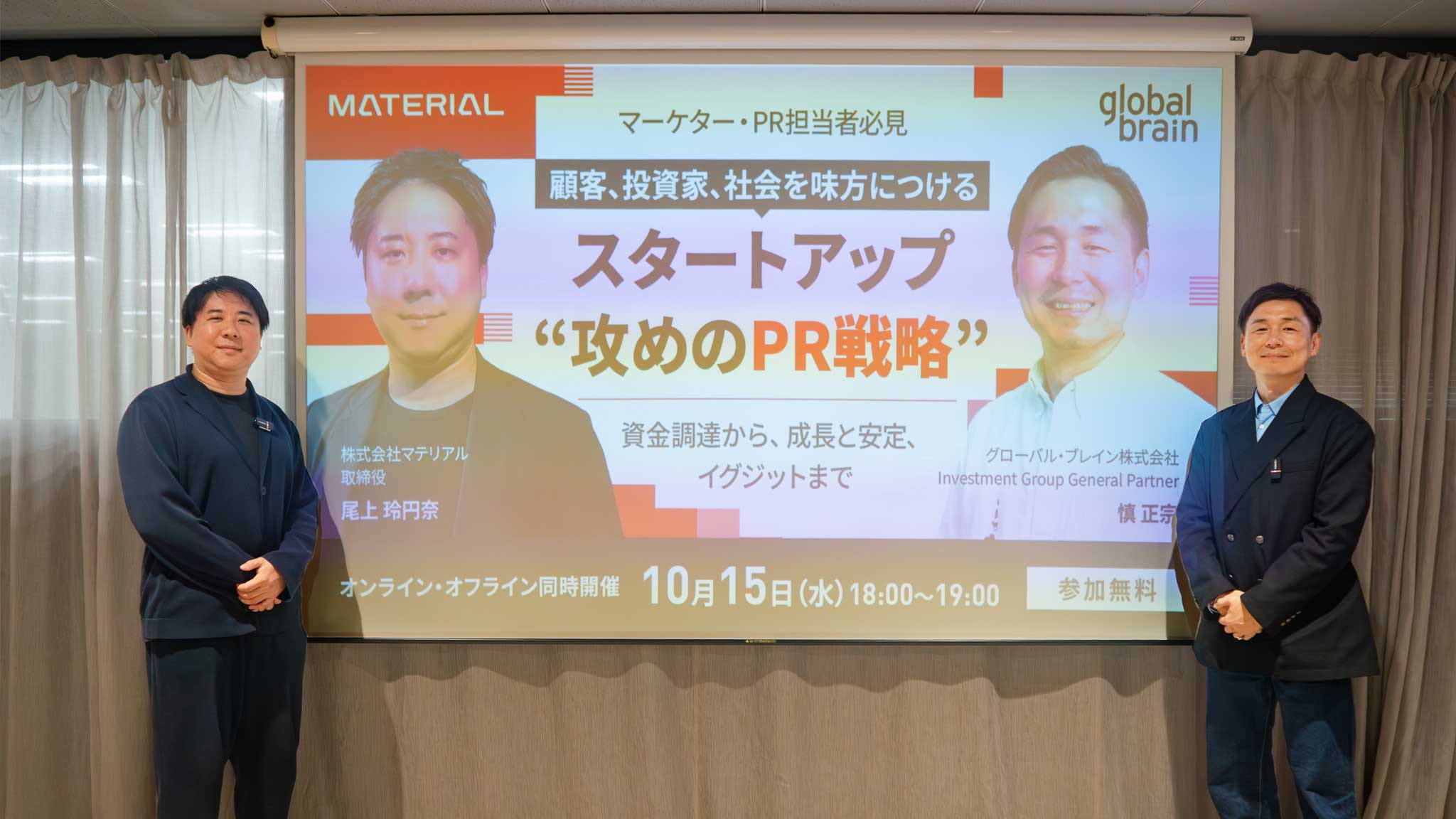
(Note: This article is a recap of the session at the event “Proactive PR strategies for startups: Winning over customers, investors, and society” (website in Japanese) hosted by Material Inc. (Material), a company that specializes in branding support for businesses and products.
PR’s role changes with each phase
The role and purpose of PR significantly changes depending on the startup phase.
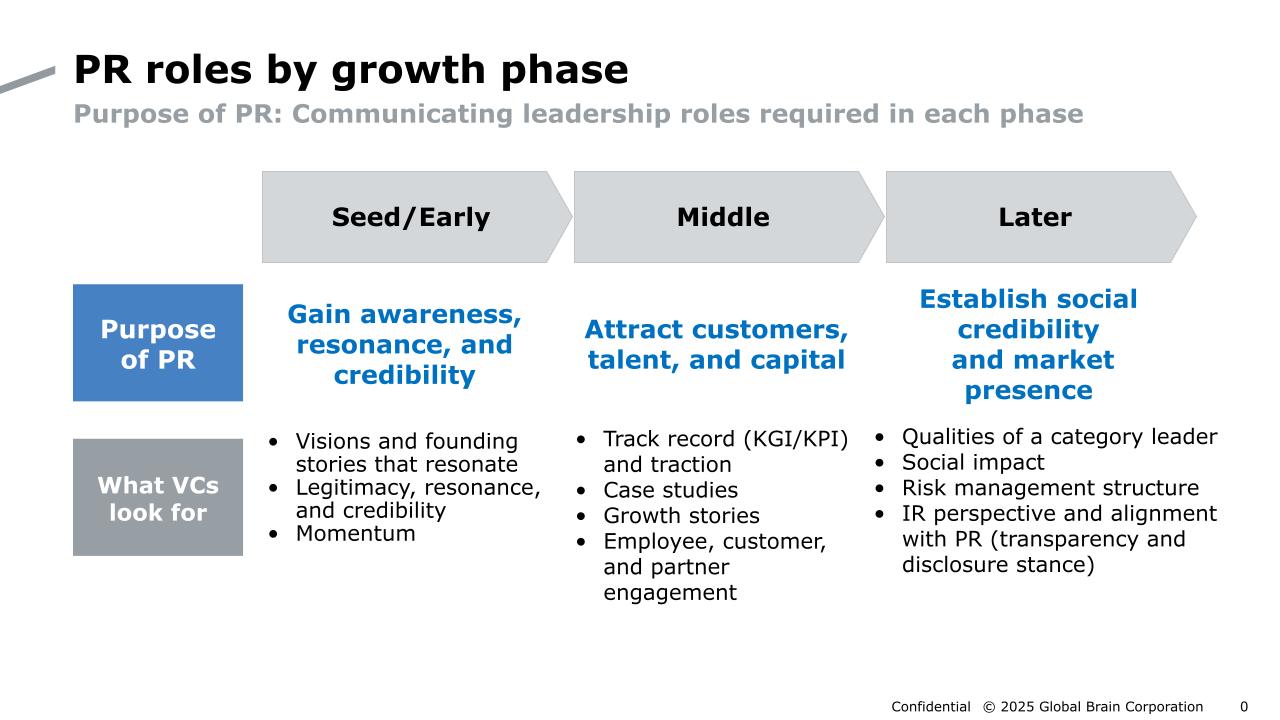
During the seed and early stages, the primary focus is to gain awareness and credibility. In the mid stage, startups need to take action to secure customers, talent, and capital to solidify the business foundation. And, in the later stage before an IPO, they need to make efforts to establish market presence and earn social credibility.
These PR activities should play exactly the role that VC firms expect from the leadership. When you look at PR this way, you can see that its role is to support the leadership’s work, and pursuing the number of media coverage is not the most important aspect. Keeping this in mind, let’s take a look at the specific roles of PR across the following three phases.
1. Seed and early stages: Gaining awareness and credibility
The primary job for an early-stage startup leadership is to gain market awareness, build credibility in its business, and recruit founding members who resonate with the company mission. Similarly, PR strategies should focus on actions that gain awareness, credibility, and resonance.
VC firms considering investments in startups in the initial phase also look for clear visions and founding stories that resonate, tangible momentum, and enough credibility that makes VC firms want to support them.
PR initiatives to achieve this include securing media coverage of the founding story highlighting the founder’s passion and vision, issuing press releases about funding rounds, and sharing content about the founding members and company culture on social media platforms, note (a prominent Japanese media platform designed for creators to publish text, images, audio, and videos), etc.
But at the same time, we must understand that seed- and early-stage companies face organizational challenges too. They often have no dedicated PR personnel, and the CEO or the management team may have to lead the communications themselves. Likewise, since members in HR or marketing may handle PR as well, the utilization of external resources is also a major point of discussion.
2. Early and mid stages: Building a foundation and driving growth
The early-to-mid stage, around Series A to B, is a period to build the foundation for business growth and to attract customers, talent, and capital exponentially.
One of the effective PR efforts for this is to share customer case studies and use cases for driving customer acquisition and market penetration. Publishing employee interviews and articles about company culture are also necessary for attracting growth-driving talent.
Around this phase, a dedicated PR personnel is most likely involved, so utilizing external PR agencies to broaden media relations and increase reach are also effective.
3. Later stage: Gaining social credibility and establishing a market
In the later stage before an IPO, companies must establish market presence and a solid thought leadership while gaining social credibility. Building the risk management structure including crisis communications, is also crucial during this phase. VC firms evaluating startups in this stage focus not only on revenue growth but also on industry-leading presence, social impact, and influence.
PR initiatives for this purpose include sharing activities that create market trends as an industry leader, social contribution initiatives, and views on sustainability. With the organization growing bigger, another key point is whether PR and investor relations (IR) have been integrated as a structure to communicate information in a transparent manner.
The co-speaker of the event, Reona Onoue, Director of the company Material, also mentioned the importance of considering media relations, IR, and government relations (GR) comprehensively.
He has consistently emphasized that IR, GR, building relationships with the media, etc. should not be treated separately, but as integrated activities to maximize the effectiveness through a multiplier effect. At this event too, he stressed the importance of strategically building stakeholder relationships; for example, if startups can leverage government or administrative policy announcements to drive both earned and owned media and reach a wider audience, they can create a larger societal momentum.
Case study: trifa, a startup offering global eSIMs
As an example of PR initiatives for early- to mid-stage startups, I would like to present trifa Inc. (trifa), a provider of a global eSIM app. GB’s Value Up Team has supported this startup in growing its business.
Its eSIM app, also called trifa, was steadily growing, driven by its novelty and the spread of smartphones.
Aiming for further growth, trifa planned a large-scale promotional campaign that included TV commercials. Since this was its first attempt to launch such an extensive marketing and PR initiative, they decided to work with the Value Up Team to lay the groundwork, such as defining objectives and goals as well as methods for measuring effectiveness.
Below are the three objectives of the strategy we formulated with trifa. Rather than focusing solely on metrics like the number of media coverage or likes on social media, we clearly defined objectives linked to business growth.
- Achieve revenue growth: Raise awareness of eSIMs as an option for overseas communication and increase revenue through large-scale promotion during the summer vacation period (June to August) when the number of travelers increase
- Create a new category: Present an option to the market, explaining that eSIMs are more convenient than mobile Wi-Fi services, and create an entirely new category
- Establish positioning: Establish trifa’s position as the forerunner in the newly-created category
To achieve these goals, the TV commercial featured a popular celebrity that appeals to all ages and genders, projecting an undisputed market leadership and establishing a classic, premium brand image. It also highlighted the advantages of eSIM as a new solution by emphasizing the common frustrations associated with mobile Wi-Fi.
PR efforts also helped maximize the impact of the TV commercial. Aside from just aiming for exposure on entertainment media about the commercial itself, trifa announced its business strategy at the same time, positioning the company as the leader in eSIMs and secured coverage in economic and IT media as well. We earned over 500 media coverage, including major Tokyo-based key stations and major regional stations.
Examples of business and tech media coverage
- [Toyo Keizai Online] trifa experiences rapid growth offering global eSIMs, eliminating the need for rental Wi-Fi. No. 1 in the domestic market with support in Japanese. Market projected to reach JPY 40 trillion by 2034 (article in Japanese)
- [ITmedia Mobile] The drivers behind the rapid growth of trifa, a startup that offers global eSIMs: Service designed based on user experience, direct partnerships with overseas carriers as its strengths (article in Japanese)
As we confirmed results within just two weeks from the launch of the initiative, the promotion, which was initially planned only for the Greater Tokyo Area, was expanded to the Greater Osaka Area. This brought significant success in business, including record-high app downloads and sales.
Including these marketing and PR efforts, trifa and the Value Up Team worked on business improvement measures for approximately one year and boosted the startup’s revenue sevenfold from the previous year. This is an excellent example that shows how PR can contribute to establishing the position within the market and have tangible impact on its business.
Three key PR challenges and their solutions
Let’s look at the common PR challenges and points to keep in mind regardless of startups’ phases. These can be broadly categorized into the following three points.
1. Objective and goal setting: Overemphasis on numerical KGI/KPIs
The first is how to measure the effectiveness of PR.
In many cases, the effectiveness is measured solely by media coverage or page views, or explained only in terms of advertising value equivalency. While these are certainly the metrics to follow, PR efforts must be linked to business management as I mentioned in the beginning. Objective and goal setting must align with this and be executed with a clear understanding of how it will lead to business impact including strengthening recruitment, generating leads, or boosting sales.
Related to this, Onoue-san discussed the impact of media exposure on sales activities during the event. He explained that articles on online media often remain accessible for a long period of time, making them the ultimate SEO content. He described them as something that supports the “ground battle” of sales representatives doing business negotiations by providing support through “air combat.” This is precisely the idea that takes into account the correlation between PR and the impact it has on business, and such achievements should ideally be shared within the company.
2. Operational structure (Management-PR collaboration)
Startups also often face numerous challenges related to the operational structure of their PR efforts.
Particularly in the early stage, startup PR is often handled by a single person or someone with multiple responsibilities, which leads to a situation where PR activities are difficult to carry out due to lack of networks, know-how, and experience. Conversely, in the mid and later stages, there are some cases where PR is entirely outsourced to external support companies.
Regardless of a company’s phase, executives should actively be involved in PR activities, as it plays a central role in a business strategy. To adopt PR initiatives aligned with business operations, the management team and PR persons must work closely together. Situations where executives never attend PR meetings should be avoided.
3. Operation and management: Lack of risk management
As startups enter the later stage where they attract greater public attention, the importance of crisis management increases. However, in reality, risk management, such as establishing crisis management manuals or task forces, often gets pushed aside as companies prioritize business growth.
In recent years, social media posts by executives and employees have been leveraged to build business momentum. But continuing to post without establishing guidelines will risk personal statements sparking backlash or misunderstandings, potentially leading to irreversible damage.
To avoid such risks and make sound decisions, Onoue-san emphasized the importance of finding external professionals who can be good advisors for communication matters. He stressed that it is essential to have an environment where startups can get an objective perspective and advice from outside parties and to have someone raise concerns and question why something is happening for things that have become standard practice within the company.
Risk management is also crucial from a VC perspective. At GB, we rigorously examine past communication and public statements of companies and leadership during the investment process to gauge their reliability. This underscores that PR plays a vital role that may significantly impact the company’s finance.
PR is a core pillar of a business strategy
PR is not merely a public relations activity; it is a vital part of the business strategy that must be closely aligned with the leadership’s responsibilities.
Especially for startups that need to rapidly scale their businesses, PR efforts must constantly be guided by the perspective of how they can tangibly impact business growth and recruit top talent.
I hope this article provides some insight for startup leadership and those involved in PR.
Under our mission of “bringing unimaginable innovation into society,” GB will continue to post information and drive initiatives to support the business growth of startups.
Edited by GB’s Brand Communication Team

Masamune Shin
Global Brain Corporation
Value Up Team
Masamune joined GB in 2020 and launched the Value Up Team that provides post-investment support. As the team leader, he supports portfolio companies in achieving business growth.