How trifa Designed its Organizational and Personnel Systems Without Slowing Down its Early-Stage Startup Business
This article delves into how trifa, a Japanese startup that provides an eSIM app for international travelers, developed its organizational HR framework together with the independent venture capital firm Global Brain’s hands-on support team.
trifa Inc. (trifa) provides an eponymous eSIM app, trifa, for international travelers. As an early-stage startup with a little over dozen employees, trifa was concerned that they did not have a defined compensation and job grading system.
To address this, they worked closely with the Value Up Team (VUT), the hands-on support team of Global Brain (GB)—a Japanese independent venture capital firm and an investor in trifa. trifa and VUT worked together to build a grading system and design an onboarding system for new hires, creating a compensation structure and onboarding experience that are well received by employees.
While early-stage startups tend to prioritize business and product development and sideline organizational HR system development, how did trifa, a startup in such a stage, manage to pull off its system design? We asked trifa’s CEO Masatoshi Kana, Executive Officer Kentaro Nagai, and VUT’s Takahito Yabuta to share the key points for building an organizational foundation without compromising its business speed or scalability.
Summary of the support
[Challenges]
-
No compensation and evaluation system: Without clear criteria for salary increases, trifa struggled to provide consistent and convincing compensation and performance evaluations.
-
Anxiety in hiring senior-level talent: There was a vague anxiety about hiring seasoned professionals with a high level of maturity as they tend to have more impact on the organization.
-
Lack of an onboarding system: The onboarding system was not in place nor was the environment needed to accommodate senior-level talent.
[Achievements]
-
Designed and implemented a grading system: Developed a grading system in three months and adjusted existing members’ salaries. This also fostered members’ intrinsic motivation for growth.
-
Established an onboarding system: Defined the ideal state for new hires after joining the company and specified the frequency and content of 1-on-1 meetings. Also successfully facilitated the smooth onboarding of senior-level talent.
-
Visualized the organizational plan: Defining the HR system enabled the creation of a concrete recruitment plan and organization chart leading up to the IPO.
Why trifa established an HR system for only a dozen employees
──Let me ask you about the situation and challenges you faced when you started working with VUT.
Kana: Our initiative with VUT started around September 2024. At that time, we had only a dozen or so employees, and our HR system was still largely underdeveloped.
Our biggest concern was the criteria for evaluation and compensation. At that time, trifa had no concrete compensation criteria, and I decided everyone’s salaries all by myself based on their previous salary levels. I believe neither I nor my team members felt fully convinced by the evaluations.
Thinking about our future growth, I knew that we could not keep doing it this way. I wanted to build an organization early on where every member is satisfied with their work and evaluation.

──Such a situation is not unusual for a startup with a dozen or so employees, and establishing an HR system could have waited until later. Kana-san, why is it so important for you to prioritize a satisfying work experience?
Kana: That has a lot to do with what I learned at the startup I previously worked for. When I joined the startup, it had around 20 employees, but by the time I left, it had grown to about 100. Consequently, a gap emerged in the compensation structure between the new employees who were hired based on market value and those who had been with the startup since its founding, which is a typical issue faced by fast-growing companies.
This is probably unavoidable for growing companies. What I learned from this is the importance of thorough communication between the management and employees about the reasons and background behind the disparity and creating a system that is mutually acceptable. This experience inspired me to build a company where people can work with conviction under a highly transparent evaluation system. So, at trifa, I decided to focus on building the foundation for organizational HR early on.
──Yabuta-san, how did you see trifa’s challenges at that time?
Yabuta: At the kickoff, I specifically asked about trifa’s organizational scale, business status, how well the mission, vision, and values were integrated into the team, as well as its roadmap for the next two to three years including Kana-san’s own aspirations.
Among them, I thought the most pressing issue was that they did not know how to grant pay raises. Despite Kana-san’s commitment to rewarding hardworking employees, there was no framework for raises because they did not have a clear criteria. To tackle this issue, I started the support by focusing on how to implement a fair and convincing compensation system.

Building a grading system in three months
──What steps did you take to build the compensation system?
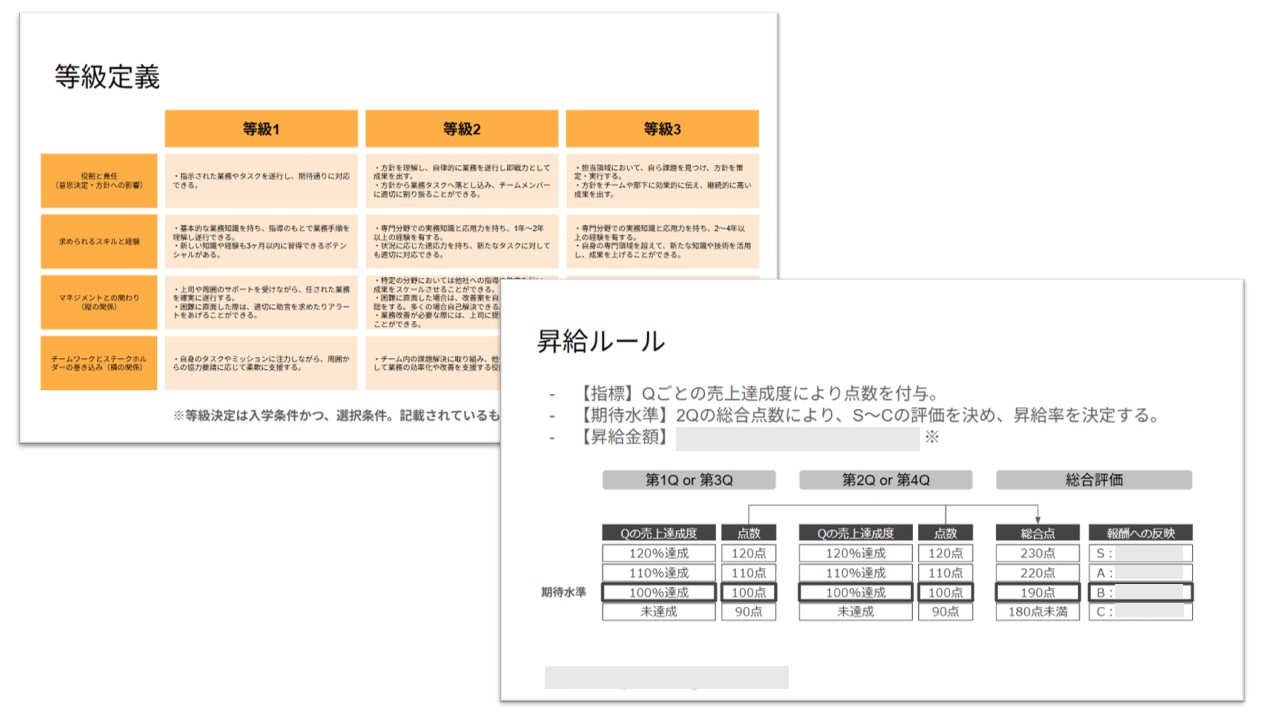
Yabuta: We started by building a grading system. This categorizes employees into three or five grades based on their skills, experience, and roles. We then determined the corresponding compensation ranges.
There were two key points to this. First was whether the grade definitions were convincing and acceptable to the employees. Second was whether the compensation reflected the labor market standards. We created and showed the draft definitions and requirements to Kana-san and Nagai-san and refined them to better fit trifa’s culture and situation. Thanks to their proactive commitment, we completed the first version of the grading system in about three months.
Nagai: While my primary focus is on the business side, I stepped in as an HR representative from the discussions for this grading system.
As I am trifa’s first employee with a long tenure at this company, I remember Kana often said, “I want to ensure that no employees are left behind as the company grows.” Personally, it is great that this grading system has clarified each employee’s target role and position, establishing a standard that allows them to grow in line with the company.
──After the grading system was finalized, how did you proceed with its implementation?
Yabuta: The next step was assigning employees to their respective grades. As we assigned individuals—this person to grade 2, that person to grade 3—we identified discrepancies with their current salaries and determined the amount of their pay raises accordingly.
Kana: This phase required the most discussion and time in this whole process. Assigning who is which grade naturally requires careful consideration. There may be members whose contributions Nagai and I might not fully see, so we made sure to thoroughly capture those aspects and leave no achievements unrecognized.
We were fortunate that around the same time, other VUT members like Shin-san and Ito-san joined us to support our business. The VUT team worked as if they were one of us, deeply engaged in our company and genuinely committed to growing our business, so we were able to take in their assessments of the members’ contributions in a fair and unbiased manner. Since these comments came from the people we trusted, we could be completely open with each other without any room for doubt.
We also paid full attention to how we communicated the grades to the members. We sought advice from Yabuta-san on how best to do it.
Yabuta: When communicating grades and salary to employees, the key is to use positive language. Instead of pointing out what they are not doing well or what they are lacking, you should say, for instance, “You have the potential for grade 3 and we have high expectations for you, but currently you are at grade 2, so let’s work together to get to the next level.”
Kana: The grading system is not just about having different ranks; it clearly articulates the scope of responsibility and management skills required for each grade. By breaking down these definitions and communicating the grades in an objective manner, we received almost no complaints or pushback from the members.
──How has the grading system changed the behavior of your employees?
Kana: Since we introduced it, some have been coming in to ask, “How can I improve this area?” I really feel the grading system has become a roadmap for our members’ growth.
Nagai: Up till then, there was some ambiguity about how to achieve higher evaluations. The grading system now serves as a common language for understanding what the company expects. It has also made it easier to give feedback to the members.

Onboarding is crucial especially for senior-level talent
──Alongside the grading system, I heard that you also supported the establishment of an onboarding system for new hires. What prompted this initiative?
Yabuta: At the time, trifa did not have a clear image for recruiting and welcoming senior-level talent. Having only been in business for a few years with limited recruiting experience overall, they were simply not used to recruiting such talent.
Recruiting senior-level talent is essential for company growth, and onboarding is particularly crucial for these individuals. Many startup founders assume that senior-level talent will deliver results even without support, but in reality, this is not the case. Because of their extensive experience, existing members often find them unapproachable or the new hires themselves may have lingering frustrations from unresolved minor questions.
Coincidentally, trifa had just made a job offer to a senior-level candidate, so we took the opportunity to design the onboarding process together.
──What were the specific actions you took?
Yabuta: We focused on three main areas.
First, we articulated the ideal state we want new hires to achieve after one month and three months. This ideal profile is shown to each individual during onboarding.
Second, we set the frequency and determined the topics for 1-on-1 meetings. While close communication during onboarding is essential for new hires to be able to demonstrate their skills from the start, the meetings may become a mere formality if you have no prepared topics, and you might end up saying, “Let’s skip it because we have no particular topic for now.” We listed questions for these 1-on-1s and refined them with Nagai-san.
Third is conducting regular meetings between new employees and myself. This was provided as an opportunity to objectively check whether they were communicating well with Kana-san and whether they were able to express themselves freely within the company.
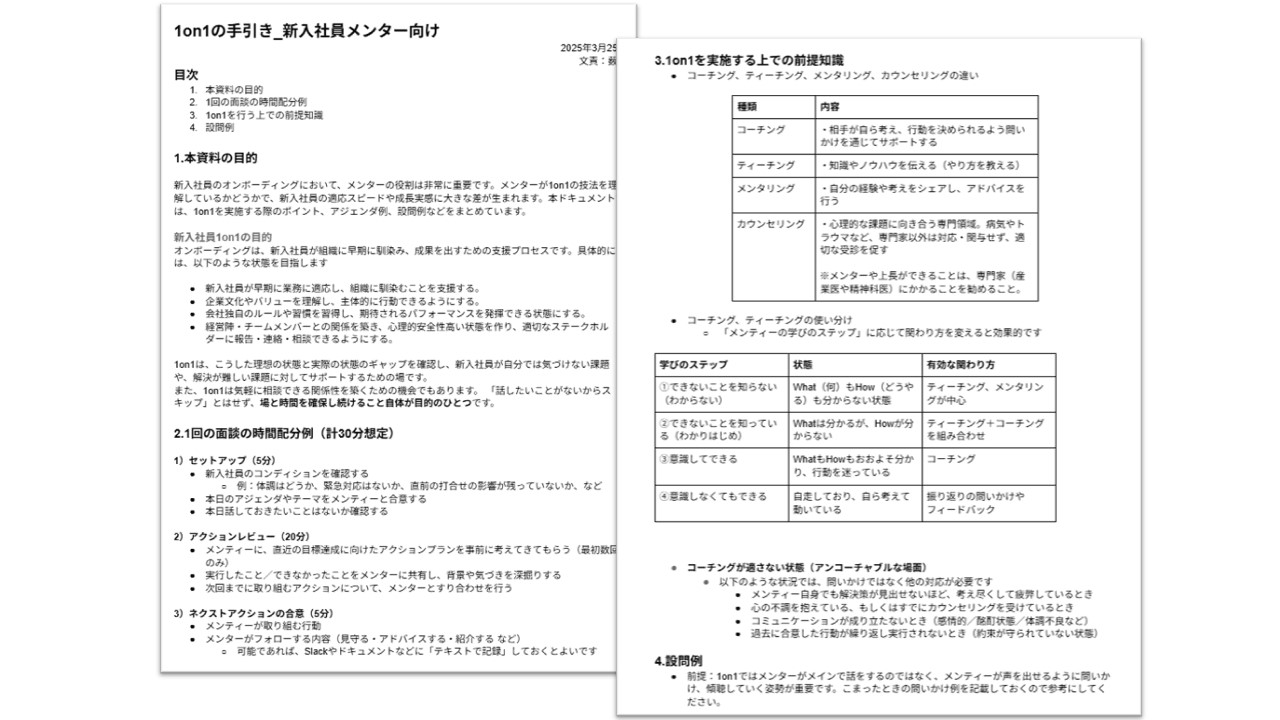
Kana: For the first month after joining, I held weekly 1-on-1s with the new hire mentioned earlier, while Nagai and the members directly involved in the new hire’s work held daily 1-on-1s .
Nagai: This was my first time doing daily 1-on-1s, and they were very effective. Since I was not directly involved in day-to-day operations, I believe the meetings were more of a place to answer minor questions like, “At my previous job, we used meeting rooms like this, but how does it work at trifa?” Those kinds of minor things are hard to bring up in monthly or weekly 1-on-1s, so it was great that we were able to communicate on a daily basis.

──How has the new hire been performing since then? Also, has trifa seen any company-wide changes since implementing the onboarding system?
Kana: He is doing an incredible job, far beyond what we imagined. He has blended in well with other members and has become what you might call the backbone of trifa.
This experience instilled significant confidence in our organization. Successfully recruiting and bringing senior-level talent on board convinced the management team that we can—and should—accelerate the recruitment of such talent. This was a big change for us.
Yabuta: When I heard about this change during the support review meeting, I almost cried (laughs). trifa has even coined its own term, core-talent acquisition, viewing senior-level talent as the foundational trunk of the corporate tree. While trifa was hesitant about recruiting such talent just a year ago, seeing them transform this much is an incredible evolution.
trifa’s vision for the future, empowered by the HR system
──Early-stage startups tend to prioritize revenue growth and product development so much that they leave the HR system development as an afterthought. What are the essential points for establishing a solid HR foundation without compromising the scale and speed of the business?
Nagai: Objectivity is crucial for a grading system. Since the company is small and everyone knows each other’s personality, reacting on a case-by-case basis can undermine the system, like “Nagai does not need to consider this metric” or “XX-san is not good at this, so we will make an exception.” I recognize the importance of fairness and objectivity in evaluating every member as we operate the system.
Kana: In terms of objectivity, appointing Nagai as the person in charge of organizational HR was a very good move. My perspective is not absolute, and I now have someone inside trifa with whom I can discuss what constitutes the optimal organizational HR structure.

Yabuta: That is an important perspective. With a team of up to about 100 people, the CEO can make all the decisions if he or she wants to. But it is truly impressive that trifa assigned a dedicated person to create a convincing and objective system even while the organization is still lean.
It is also important not to create a full-fledged HR system with too much detail early on. While HR systems or grading systems can sound grand and complex, the system needed in the early stage is not like that. The key is to start simple with something that does not affect business scalability and to explain this to the employees clearly so they can understand the lean approach.
──Looking back on the series of initiatives, what do you feel about the value and significance of startups establishing HR systems?
Kana: Building a grading system has been highly significant. Not only has it created a salary benchmark for current employees but it has also allowed us to concretely map out hiring plans and organization charts leading up to the IPO. This has significantly improved the clarity of our hiring strategy. We know exactly when and how many people we need at what grade in which positions.
Previously, we only used vague terms like junior or senior. Having clear indicators such as grades now allows us to create a much more precise hiring plan. I believe HR systems not only improve current work practices but are also meaningful to establish for future business and organizational planning.
Nagai: The onboarding system has had a positive impact on existing members in addition to new hires. When people are informed beforehand that we are hiring someone who we hope will be at this level after three months, they can welcome them with peace of mind. Giving this announcement makes all the difference in the mindset of the existing members. Establishing the onboarding system was definitely worthwhile, and I strongly believe we must continue refining it going forward.
──Thank you. Finally, now that the HR system is in place, could you share your vision for trifa’s organization?
Kana: Our immediate challenge is further evolving the stock option program we have already implemented. Here too, fostering a sense of conviction among our employees is our top priority.
Nagai: Now that the foundation of the system is in place, the focus shifts to how we operate it. We want to solidify the procedures, such as who provides evaluation feedback and at what intervals. Once this is established, I believe members will be able to more concretely envision their future about how they will work and grow at trifa. I am fully committed to making this happen.
Note: Affiliations, titles, and figures are as of the time of coverage. (Interviewed and written by the Universe Editorial Team)